
Ellora Caves: Timeless testament to rock-cut architecture of India
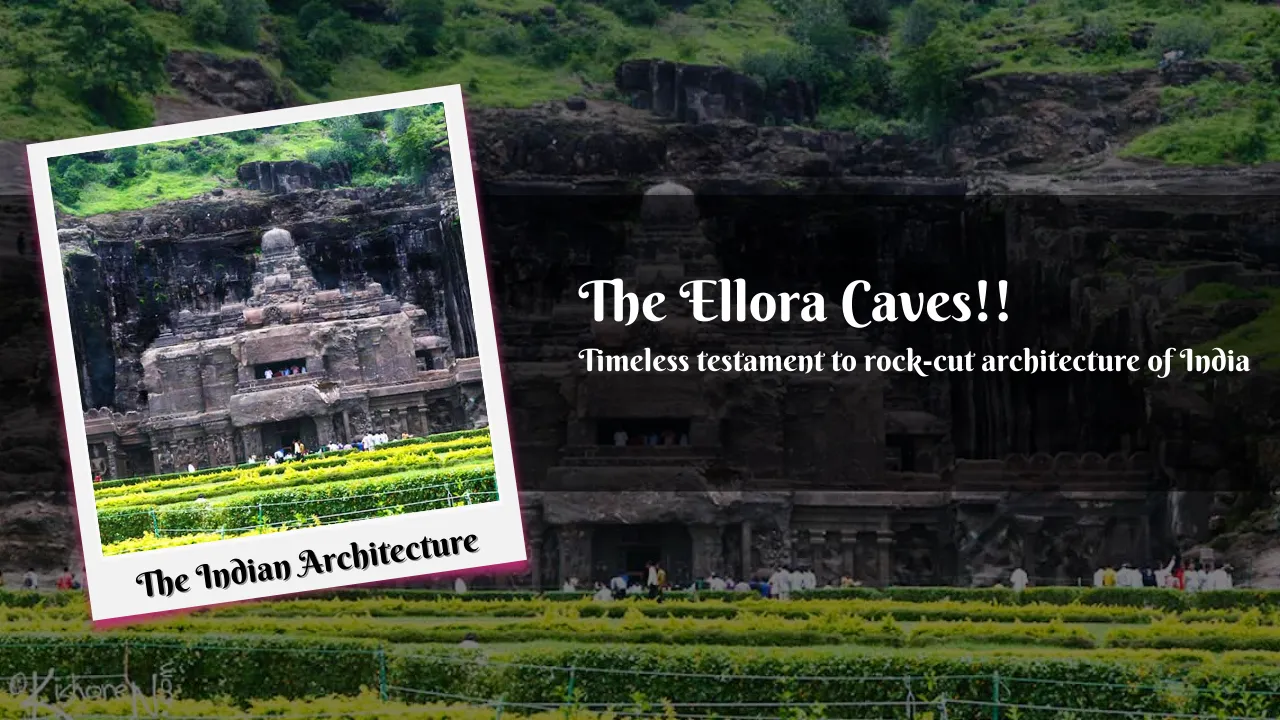
Hello guys, welcome back to my blog. Have you ever thought how people more than 1,200 years ago cut a whole temple out of one single rock, without any machines? Well, at the Ellora Caves in Maharashtra they did exactly that. Today I am going to tell you about the history of Ellora Caves, their Buddhist, Hindu and Jain caves, and the amazing Kailasa Temple. I will also share how to reach there, the timings and what is the best time to visit. So let’s start.
What are the Ellora Caves?
Ellora Caves are a group of rock-cut temples and monasteries at Verul village, around 30 km from Chhatrapati Sambhajinagar (earlier called Aurangabad) in Maharashtra. Local people also call them “Verul Leni”. There are more than 100 caves in these hills, but the 34 main caves are the ones visitors see. As per UNESCO, these 34 caves are cut side by side into a basalt cliff of the Charanandri hills, and they stretch for more than 2 km.
The most special thing about Ellora is that it has caves of three religions at one place. Caves 1 to 12 are Buddhist, caves 13 to 29 are Hindu and caves 30 to 34 are Jain. If you ask me, this is the best example of how different religions lived together peacefully in ancient India. UNESCO also praises this spirit of living together, and Ellora became a World Heritage Site in 1983.
Quick Facts About Ellora Caves
Before going in detail, here is a quick table so you can get the basic idea.
| Fact | Details |
|---|---|
| Location | Verul, near Chhatrapati Sambhajinagar (Aurangabad), Maharashtra |
| Total caves | 34 main caves (more than 100 in the hills) |
| Religions | Buddhist (1–12), Hindu (13–29), Jain (30–34) |
| Time period | Mainly around 600 to 1000 CE |
| Most famous cave | Cave 16, the Kailasa Temple |
| Built by | Many kings and patrons, especially the Rashtrakutas |
| UNESCO status | World Heritage Site since 1983 |
| Timings | 6 AM to 6 PM, closed on Tuesday |
| Entry fee | Around ₹40 for Indians, ₹600 for foreigners |
| Best time to visit | October to March |
History of Ellora Caves
The caves were not made in one go. As per UNESCO, the work happened in three phases between the 6th and 12th centuries, and the main caves date from around 600 to 1000 CE. Kings, rich merchants and traders all gave money to make them.
Who Built Ellora Caves?
Some of the early Hindu caves, like Cave 21 and Cave 29, are linked with the Kalachuri rulers. Later, the Rashtrakuta dynasty made Ellora really famous. As per the Archaeological Survey of India (ASI), Ellora was called Elapura in Rashtrakuta inscriptions and it is said to have been their capital for a short time. Cave 15 has an inscription praising King Dantidurga from around 753 AD, and the great Kailasa Temple was made under the next king, Krishna I.
One more interesting thing. Earlier people thought the Buddhist caves were the oldest ones at Ellora, but as per Wikipedia, modern scholars now believe the Hindu caves were started before the Buddhist caves. I really like how history keeps changing when we learn more.
Never Lost Like Ajanta
Unlike the Ajanta Caves, Ellora was never forgotten, because it was close to an old trade route. As per ASI, an Arab geographer named Al-Masudi wrote about these caves in the 10th century. In 1352, the Bahmani ruler Sultan Hasan Gangu visited Ellora, and the roads were even repaired for his visit. Old Marathi books like Lilacharitra and Saint Dnyaneshwar’s Amrutanubhav also talk about these caves. Later, in the 18th century during the time of Ahilyabai Holkar, the Kailasa Temple was given a lime plaster with ochre colour paintings on the outside.
Buddhist Caves (Cave 1 to 12)
The Buddhist caves are at the southern end of Ellora, so these are the first ones you will see. As per UNESCO, they were made between the 5th and 8th centuries. Most of them are viharas, which means monasteries where monks lived and studied, with small rooms for sleeping.
Cave 5
Cave 5 is the biggest cave of the early Buddhist group, as per ASI. It has two long rock-cut benches running through the middle of the hall, and it is believed that monks sat here together for group prayers.
Cave 10 – Vishvakarma or Carpenter’s Cave
This is the most famous Buddhist cave and honestly my personal favourite. It is the only chaitya (prayer hall) in the Buddhist group and it was made around 650 CE. Its ceiling has stone ribs which look exactly like wooden beams, that’s why people call it the “Carpenter’s Cave” or Sutar-ki-jhopdi. At the end of the hall there is a stupa with a huge seated Buddha in teaching pose. When you see photos of the inside, it feels like a big stone church.
Cave 11 and Cave 12 – Do Tal and Teen Tal
Caves 11 and 12 are multi-storey monasteries, called Do Tal and Teen Tal. As per UNESCO, Cave 12 (Teen Tal) is a three-storey monastery and the largest of its kind at Ellora. These caves also show the Vajrayana form of Buddhism, with many Buddhist deities carved inside. I think it is just amazing that people cut three full floors inside a rock without any modern machine.
Hindu Caves and the Amazing Kailasa Temple (Cave 13 to 29)
There are 17 Hindu caves in the middle part of Ellora. As per UNESCO, they were made between the 7th and 10th centuries, and the most important ones are Cave 15, 16, 21 and 29.
Cave 16 – Kailasa Temple
This is the star of Ellora and honestly one of the most amazing buildings in the whole world. The Kailasa Temple is dedicated to Lord Shiva and it is made to look like Mount Kailash, his home. As per Guinness World Records, it is the largest building carved out of a single piece of rock, around 50 m long, 33 m wide and 30 m high at its tallest point.
It was made in the 8th century under the Rashtrakuta king Krishna I. The Indian Culture portal says it was first named Krishneshvara after him, and some experts believe the work went on for more than a hundred years under later kings too.
As per ASI, the temple has an entrance gateway, a Nandi shrine, the main temple and corridors all around the courtyard, and it follows the Dravidian (South Indian) style. Its base is full of carved elephants and lions, which honestly makes it look like the temple is sitting on their backs. The main shrine rises around 23 m above this base. The walls have scenes from the Ramayana and Mahabharata, and UNESCO especially mentions the sculpture of Ravana trying to lift Mount Kailash. You can also still see some old paintings on the ceiling of the front hall.
There is also a lovely legend about this temple. It is said that a king built it overnight to ask Lord Shiva to cure his sick queen, and by morning the temple was ready and the queen was healed, as per Incredible India. Of course it is a legend, but I really like these stories.
Cave 15 – Dashavatara Cave
This two-storey cave is named after the ten avatars of Lord Vishnu. It is very important for history because, as per ASI, it is the only Hindu cave at Ellora with an inscription, which praises King Dantidurga and lists the family of the Rashtrakuta kings. Inside you can also see a beautiful Shiva Nataraja (dancing Shiva).
Cave 21 – Rameshwar Cave
Rameshwar is one of the early Hindu caves and it is linked with the Kalachuri rulers. Its entrance has beautiful carvings of river goddesses, and the goddess Ganga standing on a makara (a mythical sea creature) is especially famous, as per Lonely Planet.
Cave 29 – Dhumar Lena
Dhumar Lena is one of the earliest and largest Hindu caves at Ellora. Its design looks a lot like the famous Shiva cave on Elephanta Island near Mumbai. During monsoon a waterfall flows close to this cave, which makes it look even more beautiful.
Jain Caves (Cave 30 to 34)
The Jain caves are at the northern end, around 1 km after the last Hindu cave, so most people take the bus inside the complex to reach them, as per Lonely Planet. As per UNESCO, these caves were made last, between the 9th and 12th centuries, and they belong to the Digambara sect of Jainism. They are smaller, but the carving work is very fine. If you ask me, these are the most underrated caves of Ellora, because many tourists get tired after Kailasa and skip them.
Cave 30 – Chhota Kailash
Cave 30 is called Chhota Kailash (small Kailash), because it is like a small copy of the Kailasa Temple, as per ASI.
Cave 32 – Indra Sabha
Indra Sabha is the finest Jain cave at Ellora. It is a double-storey cave, and in its courtyard there is a life-size elephant carved from the rock, standing in front of a 9.4 m tall pillar called Manastambha, as per ASI. Inside the shrine there is a seated statue of Lord Mahavira, and you can also see images of Parshvanatha and Gomateshwara (Bahubali). The upper floor is the most detailed one, so please don’t miss it.
Cave 33 – Jagannath Sabha
Jagannath Sabha is the second largest Jain cave at Ellora. Caves 32 and 33 are also connected by a passage on the first floor, and this part has some of the finest old wall paintings of Maharashtra, as per ASI.
How Were These Caves Carved?
This is the part which surprises me the most as an architecture lover. As per ASI, the caves are cut into the basalt rock of the Deccan Trap. The workers did not build anything with bricks or stones, they just cut away the rock and the shape came out.
For the Kailasa Temple they did something even more crazy. As per ASI, a huge block of rock was first separated from the hill, and then this block was carved into a temple from top to bottom. The Indian Culture portal says that one and a half to two million cubic feet of rock was removed just by digging the trenches around it. And as per Guinness World Records, between 150,000 and 200,000 tonnes of rock was removed for the whole temple.
Because they started from the top, they did not need any scaffolding, they just kept going down from the roof to the floor. It is also believed that while one team was cutting the rock, another team was already carving the details. And remember guys, all this was done with simple tools like hammers and chisels.
Some people on the internet even say that aliens made it. Honestly, I don’t agree with this at all. I think it just shows how talented and patient our ancient artisans were.
How to Reach Ellora Caves, Timings and Best Time to Visit
Ellora is around 30 km from Chhatrapati Sambhajinagar city, so most people stay in the city and do a day trip.
- By Air: The nearest airport is Chhatrapati Sambhajinagar Airport (IXU). As per Travel India Smart, it has daily flights from Delhi, Mumbai, Hyderabad and Bengaluru.
- By Train: The nearest railway station is in Chhatrapati Sambhajinagar, which is still called Aurangabad (AWB) on many tickets and timetables.
- By Road: Buses and taxis from the city to Ellora are easily available.
Timings and Entry Fee
As per Incredible India, Ellora Caves are open from 6 AM to 6 PM. The caves are closed on Tuesdays, as per Tour My India, so please don’t make the mistake of going on that day. Small tip guys, the Ajanta Caves are closed on Mondays. The entry ticket is around ₹40 for Indian tourists and ₹600 for foreign tourists, and you can also book tickets online through the Incredible India monument booking page. Timings and fees can change, so do check once before you go.
Best Time to Visit
The best time to visit Ellora is from October to March, when the weather is cool and pleasant, as per ixigo. The monsoon months (June to September) are also beautiful, because everything becomes green and a waterfall flows near Cave 29. But I will suggest you to avoid April and May, because as per Incredible India the temperature can go close to 40°C in May, and there is very little shade between the caves.
Places to Visit Near Ellora
- Grishneshwar Temple – One of the 12 Jyotirlingas of Lord Shiva, just around 2.3 km from the caves.
- Daulatabad Fort – A 12th century fort around 15 km away, which was once the capital of the Yadava dynasty.
- Bibi Ka Maqbara – Also called the “Taj Mahal of the Deccan”, built in memory of Aurangzeb’s wife.
- Ajanta Caves – Another UNESCO site around 100 km away, famous for its old Buddhist paintings.
Some Simple Tips
- Keep at least one full day for Ellora, there is a lot to see.
- Start early in the morning, before the heat and the crowd.
- Wear comfortable shoes and carry water, because you will walk a lot.
- If you have less time, at least see Cave 10, Cave 16, Cave 21 and the Jain caves 32 and 34.
FAQs
Where are the Ellora Caves located?
Ellora Caves are at Verul village, around 30 km from Chhatrapati Sambhajinagar (Aurangabad) in Maharashtra.
How many caves are there in Ellora?
There are 34 main caves at Ellora: 12 Buddhist, 17 Hindu and 5 Jain. In total there are more than 100 caves in these hills.
Who built the Kailasa Temple at Ellora?
The Kailasa Temple was made in the 8th century under the Rashtrakuta king Krishna I.
Which day are Ellora Caves closed?
Ellora Caves are closed on Tuesdays. The nearby Ajanta Caves are closed on Mondays.
What is the best time to visit Ellora Caves?
The best time to visit Ellora Caves is from October to March, when the weather is cool.
Final Words
So guys, this was all about Ellora Caves, the place where Buddhist, Hindu and Jain caves stand side by side. I have tried to cover its history, the important caves, the amazing Kailasa Temple and how to plan your visit, in simple words. As it is said that a picture is worth thousand words, but trust me, Ellora is something you have to see with your own eyes. Keep visiting The Indian Architecture for more such blogs.
Sources
- Ellora Caves – UNESCO World Heritage Centre
- Ellora Caves – ASI Aurangabad Circle
- Ellora Caves – Incredible India
- Ellora Caves – Wikipedia
- Largest monolithic building – Guinness World Records
- Kailasa: The Majestic Temple of Ellora – Indian Culture
- Ellora Caves – National Virtual Library of India
- Ellora Caves: A Rock-Cut Buddhist, Hindu, and Jain Religious Complex – Ancient History Sites
- Ellora caves, the wonders of Maharashtra – Magik India
- Ellora Caves – Google Arts & Culture
- Ellora Caves – New World Encyclopedia
- Hindu Caves – Lonely Planet
- Jain Caves – Lonely Planet
- Jain Caves Ellora – eSamskriti
- Jaina Caves, Ellora – Sahapedia
- Ajanta and Ellora Caves visitor’s guide – Travel India Smart
- Ellora Caves – Tour My India
- Ajanta and Ellora day trip, ticket prices – AAA TripCanvas
- Ellora travel guide – ixigo
- Best time to visit Ellora – Tapioca
- Ellora Caves – When To Be Where
Facts checked on Oct 18, 2026.