
Boiler Making Noise in an Older Home Means What?
Older homes have their own sounds. Floors creak, pipes tick as they warm and the boiler hums in the background. But when the boiler starts banging, whistling or gurgling, the sound feels different, and many owners wonder whether the appliance is about to fail.
A boiler making noise is usually telling you about water, air or heat. Banging often points to scale or a restricted flow, whistling to a narrow passage, and gurgling to trapped air. Which one you hear, and when, narrows down the cause. This article covers the common sounds, what sits behind them and which ones you should leave to an engineer.
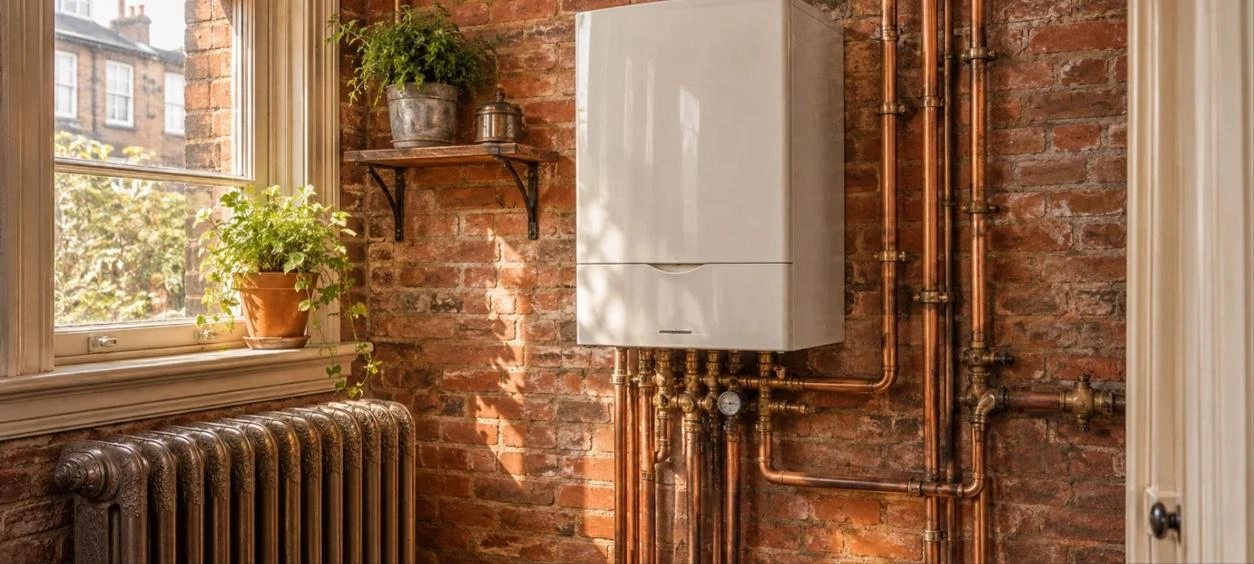
Banging or knocking
A sharp bang or a rhythmic knock from the boiler is the sound most people worry about. In an older home it often comes from limescale or sludge. Deposits on the heat exchanger make small areas of water boil before the rest, and the steam bubbles collapse with a bang.
A related cause is a flow problem. If a pump is weak, or a valve is partly closed, the water moves too slowly through the boiler and overheats in places. Systems that have been extended over the years, with new radiators added to old pipework, are more likely to show this.
Do not ignore a knock that gets louder over days. Switch the boiler off if it is violent and book an engineer, because repeated overheating shortens the life of the heat exchanger.
Whistling or high-pitched noise
A whistle usually means water is forced through a gap that is too small. A partly blocked heat exchanger, a failing pump or a radiator valve closed too far can all do this. Whistling that starts when the heating comes on and fades as the system warms often points to a flow restriction.
If the sound comes from the pipes and not the boiler, a half-closed lockshield valve may be the reason. An engineer can balance the system, which spreads the flow evenly among the radiators.
Gurgling and bubbling
Air in the system makes a gurgle that you can hear in the pipes. Radiators that are cold at the top confirm it. Older systems let air in through small leaks or when the water level changes, and the sound is worth acting on, because trapped air also reduces heat output.
Bleeding the radiators is the usual first step. If the gurgling returns within weeks, there may be a fault that keeps drawing air in, such as a leaking joint or a failing vent. Repeated air problems deserve a proper check.
Kettling and rumbling
A low rumble that sounds like a kettle coming to the boil is called kettling. It is closely linked to scale. Water trapped under deposits boils into steam, then rumbles out. Hard water areas see it more often. A system clean or descaling, done by a qualified engineer, usually addresses it.
Humming, buzzing and clicking
A steady hum is normal for many boilers, as the fan and the pump run. A new loud buzz is different. It can mean a loose part, a worn fan bearing or a vibrating panel. A clicking noise at start-up may come from the ignition system, and rhythmic clicking without a flame can point to an ignition fault.
Listen for changes rather than for noise alone. A boiler that has hummed softly for ten years and now buzzes loudly has changed, and that change is worth reporting.
Why older homes show more noise
Three features of older houses make boiler noise more likely. Pipework is often a mix of old and new sections. Systems may have been extended without rebalancing. And hard water leaves scale over many years, especially if the boiler has not had regular care.
Take a Victorian terrace where a loft conversion added two radiators and a new bathroom. The old pump now serves more demand, flow slows, and the boiler starts to knock on cold mornings. Nothing is broken, but the system no longer matches the house.
What you can check safely
- Look at the pressure gauge and compare it with the range in the manual.
- Bleed any radiator that is cold at the top.
- Check that no radiator valve is fully closed in an occupied room.
- Note when the sound happens, such as at start-up, at full heat or when the hot tap runs.
Write these notes down. They help an engineer find the cause faster than a general description of a noisy boiler.
When to call a professional
Do not open the casing of a gas boiler yourself. Call a Gas Safe registered engineer if the boiler noise is loud or getting worse, if you smell gas, if you see water leaking, or if the boiler locks out. Banging, kettling and whistling often come with low pressure, a failing pump or limescale, and a boiler repair or boiler service in London usually starts by checking those. This guide to common boiler problems in London lists other boiler faults and warning signs worth knowing about.
If you suspect carbon monoxide, leave the property and call the National Gas Emergency Service on 0800 111 999.
Noise in period and converted buildings
Older properties often carry heating pipework that has been altered several times. Pipes may run through floors, thick walls and roof voids, and each change of material or route can add a place where air collects or a pipe can move as it heats. In a converted building the boiler may also sit in a cupboard or loft space that was never designed for it, which can make ordinary sounds seem louder.
Solid floors and plaster can carry vibration a long way. A hum that seems to come from the bedroom may start in a pump or fan in another part of the house. Noting which rooms hear it most is useful information for an engineer.
Keep a simple noise diary
Intermittent noises are hard to diagnose after the fact. For a week, jot down when the sound happens and what the heating was doing at the time. Useful details include:
- the time of day and whether the heating or hot water had just switched on
- whether the noise stops once the radiators are warm
- which radiator or room seems closest to the sound
- whether the boiler pressure gauge looked different before and after
A short phone video can also help, as long as you film from a safe distance and do not open the boiler casing.
Do not ignore a change in sound
A boiler that has always made a faint hum is different from one that has started to bang or whistle. A sudden change is more important than a steady background noise, because it points to something that has shifted: pressure, flow, water quality or a part that is wearing out. Booking a check early is usually simpler than waiting for a lockout in cold weather.
A boiler that makes unusual noise is asking for attention. In an older home that request is easier to answer early, while the cause is still small.